


That goose-like honk from a Yorkie, Pomeranian, Chihuahua, or other toy breed is the signature sound of a collapsing trachea, a windpipe whose weakened cartilage flattens inward when breathing gets fast and hard. Excitement is the classic spark. The doorbell rings, your dog gets worked up, and air rushes through a softened windpipe until it briefly caves in, setting off a cough that feeds on itself. Leash pressure on the neck, hot days, and extra pounds all pile onto the same problem. As frightening as an episode sounds, the condition usually progresses slowly, and most dogs stay comfortable for years on a well-matched care plan.
Livingston Veterinary Hospital can get a close look at that honking cough with a thorough exam and digital chest X-rays, which help us evaluate the windpipe and rule out heart and lung problems that sound similar. Our veterinary care for dogs in Livingston is built around catching subtle signs of illness early, and a slowly worsening airway condition is exactly the kind of problem that rewards an early look. From there, we put together a management plan that fits your dog and your household. If the goose honk has become a regular sound at your house, request an appointment so we can hear it for ourselves.
The Goose Honk in a Nutshell
- The goose-like honk of a collapsing trachea comes from weakened windpipe cartilage that flattens when your dog breathes hard, and excitement, collar pressure, heat, and extra weight are the usual triggers.
- Most small dogs with this condition stay comfortable for years, and a blend of everyday changes and medication handles the large majority of cases.
- Sudden labored breathing at rest, blue-tinged gums, or collapse is a true emergency that needs care right away, not a wait-and-see cough.
- Simple home habits make a real difference in flare-ups: a harness instead of a collar, a lean weight, cool and clean air, and tracking your dog’s resting breathing rate.
What Is a Collapsed Trachea, and Why Does It Happen?
Tracheal collapse happens when the C-shaped cartilage rings that normally hold the windpipe open gradually weaken and flatten, so the airway narrows and caves in on itself every time your dog breathes. It usually creeps in slowly over months to years, most often in middle-aged and older toy breeds.
Certain dogs are simply built for it. Yorkshire Terriers, Pomeranians, Chihuahuas, toy Poodles, and Maltese top the list, since the cartilage they’re born with runs a little softer than it should be. Several things speed the process along: carrying extra weight, an enlarging heart, repeat respiratory infections, and ongoing dental disease.
In some dogs the softening doesn’t stop at the windpipe. The smaller airways deeper in the lungs can flatten too, which is one reason a cough sometimes lingers even after the trachea itself is well managed.
Flat-faced breeds carry an added layer of risk. Brachycephalic airway syndrome bundles narrowed nostrils, an elongated soft palate, and other obstructions that make each breath harder to pull in. Some of these dogs are also born with a hypoplastic trachea, an abnormally narrow windpipe that can be tough to separate from a collapsing one without proper imaging.
What Does a Collapsing Trachea Sound and Look Like in a Small Dog?
The signature sign is a dry, honking cough that sounds startlingly like a goose. It tends to show up right when your dog gets excited, pulls against a collar, gulps down water, or tries to breathe hot, humid air. Not all coughing in dogs sounds the same, and this honk is the one that points toward a collapsing windpipe.
Early on, the honk might be an occasional oddity that only turns up when the doorbell rings. As the airway narrows over months and years, other changes tend to creep in. Your dog may tire faster on walks, breathe harder after mild activity, gag a little after eating or drinking, or grow restless at night when lying down makes each breath feel like more work.
A cough that’s suddenly more frequent, louder, or paired with heavier breathing is worth a same-day evaluation so we can listen to it and see what’s changed.
What should I do while my dog is having a coughing fit?
Most fits pass within a minute if you help your dog settle. Work through these steps in order:
- Stay quiet and calm yourself, since your dog takes emotional cues from you and panic makes the cough worse.
- Take the pressure off the neck by unclipping the collar or loosening the harness.
- Move your dog somewhere cool, and turn on a fan or the air conditioning if the room is warm.
- Offer a small sip of water once the coughing eases, rather than letting your dog gulp it down.
- Watch the gums and the breathing as things settle, and seek care right away if the gums look blue or grey or the effort to breathe doesn’t ease.
When Is a Coughing Fit Actually an Emergency?
Most coughing fits calm down within a minute once your dog relaxes and the trigger passes, and those aren’t emergencies. What crosses the line is difficulty breathing at rest. Heaving sides, an anxious stretched-out neck, and exaggerated effort with every breath add up to a crisis that can’t wait for morning.
| Usually manageable | Call for emergency care |
| The cough settles within a minute or two once your dog calms down | Effortful breathing that keeps going even at rest |
| Gums stay a healthy pink | Gums turn blue, grey, or pale |
| Bright, playful, and comfortable between coughing fits | Collapse, stumbling, or extreme weakness |
| Breathing looks and sounds normal afterward | Open-mouth gasping and obvious panic |
Any of the signs in the right column adds up to a true pet emergency, and that’s the moment to seek immediate care. Emergency stabilization usually means getting oxygen on board, calming the panic that keeps feeding the cough, and cooling an overheated body. During our open hours we handle urgent cases, so call ahead and come straight in. After hours, calling our main line connects you with the veterinarian on call, who can tell you whether your dog can wait until morning or needs a 24/7 emergency facility right away.
How Do We Diagnose a Collapsed Trachea?
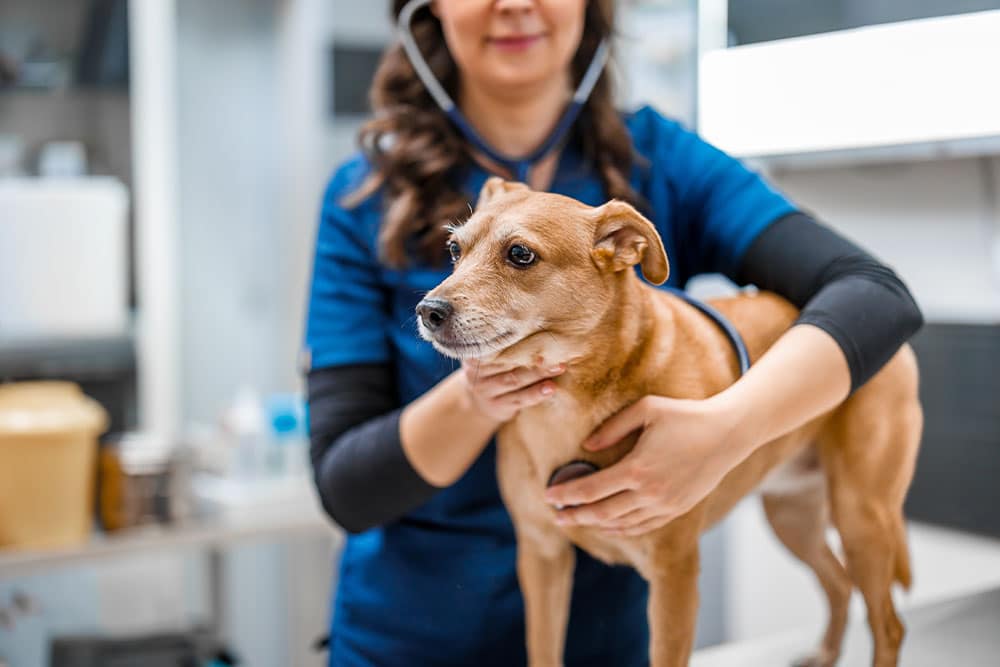
Diagnosis starts with a hands-on exam and your dog’s history, then moves to imaging. We gently feel along the windpipe, which can sometimes trigger the telltale cough, and take chest X-rays on both the in-breath and the out-breath, since a collapsing airway often reveals itself on only one phase of breathing. If you can take a video of your dog at home during an episode, that’s helpful too.
Several other problems produce a cough that sounds a lot alike, so part of the workup is ruling them out:
- Heart disease: an enlarging heart can press on the windpipe and set off a similar cough, which is one more reason chest imaging matters.
- Airway inflammation: chronic bronchitis drives a persistent inflammatory cough that can be nearly impossible to tell apart from tracheal collapse without imaging.
- Contagious illness: kennel cough can produce the same startling honk, which is why the cough’s timeline and any recent contact with other dogs matter so much during the exam.
- Reverse sneezing: this snorting, honking inhale is common in small breeds and often mistaken for a collapse episode, though it comes from irritation at the back of the nose and usually passes on its own within a minute.
- Voice box and lungs: laryngeal paralysis and pneumonia can each mimic the pattern too, so we weigh the whole picture rather than the cough alone.
When the workup still isn’t conclusive, two advanced tools can add detail. Fluoroscopy is a moving X-ray that films the windpipe flattening and springing back with each breath. Tracheoscopy lets a specialist pass a tiny camera into the airway and watch the trachea move in real time. Both are specialist procedures, and we coordinate the referral when a case needs one.
What Do the Four Grades of Collapse Mean for Treatment?
We sort tracheal collapse into four grades based on how much the airway has narrowed, and the grade guides how aggressively we treat.
| Grade | How narrow the airway is | What you might see | General approach |
| Grade 1 | About 25% closed | Occasional honking cough, easily triggered | Weight, harness, and simple changes often keep it quiet |
| Grade 2 | About 50% closed | More frequent cough, some noisy breathing | Usually medication plus lifestyle changes |
| Grade 3 | About 75% closed | Regular coughing, tiring easily, louder breathing | Medical management, and some dogs need more |
| Grade 4 | Greater than 75% closed | Marked distress, exercise intolerance | Often needs a stent or advanced help alongside medication |
Can a Collapsed Trachea Be Managed with Medication?
Most mild to moderate cases respond well to medication paired with everyday changes, and the goal is to break the cough-inflammation-cough cycle so your dog can breathe easier. There’s no single pill for it, so we build a small toolkit and adjust it as your dog’s needs shift over the years.
The pieces we reach for most often include:
- Cough suppressants: quieting a nonstop cough gives the irritated airway a chance to settle.
- Anti-inflammatories: a short course of a steroid or similar drug calms swelling inside the windpipe, and for some dogs an inhaled steroid given through a small face mask does the same job with fewer whole-body side effects.
- Bronchodilators: these relax and open the lower airways so breathing takes less effort.
- Antibiotics: reserved for the times we’ve documented a secondary infection, not used routinely.
- Sedatives or anti-anxiety medication: helpful for predictable stress like car rides, thunderstorms, or a houseful of holiday guests.
- Class IV laser therapy: targeted sessions can ease inflammation and support overall comfort, and we’ll talk through whether your dog is a good candidate.
Untreated dental disease keeps a low grade of infection and inflammation near the airway, which is one reason professional dental care belongs in the plan. Dogs with a narrowed windpipe do need extra attention under anesthesia, and that’s something we plan for rather than something that rules dental work out. And because respiratory bugs like parainfluenza, Bordetella, and canine influenza can irritate an already fragile throat, keeping up with routine vaccinations takes some of that risk off the table.
Because no two small dogs cough for exactly the same reasons, our veterinarians personalize the plan for each dog. Regular rechecks are how we catch a windpipe that’s slowly narrowing before it turns into a crisis.
When Is Surgery or a Tracheal Stent the Right Call?
Surgery enters the conversation only when severe collapse stops responding to medication. For that stage, tracheal stent placement threads a small expandable mesh tube inside the windpipe to hold it open. A stent manages the problem rather than curing it, and dogs still need ongoing medication afterward.
It isn’t a magic fix, and it carries real trade-offs. The mesh can fracture over time, tissue can grow into it, and some dogs keep coughing or pick up recurring infections. For younger dogs whose collapse sits in the neck rather than deep in the chest, surgically placed plastic rings on the outside of the windpipe are sometimes an option instead. Matching the dog to the procedure is specialist territory, so we’ll talk you through your dog’s candidacy and where the procedure can be performed, then coordinate the referral.
What Can You Change at Home to Help?
A handful of everyday habits lower how often flare-ups happen. Around Livingston they shift with the season, from dry indoor heat through a long Montana winter to the warm, still afternoons of midsummer. Late-summer wildfire smoke deserves its own mention, since smoke particles irritate an already fragile airway and hazy days are worth spending indoors with the windows closed.
- Reach for a harness, not a collar: it lifts pressure off the throat where the trouble lives.
- Keep a lean body condition: even a little weight loss eases the workload on the chest.
- Make the air easy to breathe: skip smoke, aerosol sprays, and strong cleaners, and run a humidifier through dry winter months.
- Keep the house cool and calm: heat and overexcitement are two of the most reliable triggers.
- Swap one long walk for a few short ones: shorter bursts are gentler on the airway, and a few minutes of warm-up indoors helps before heading into cold winter air.
- Stay calm during a coughing fit: your steady, quiet response helps your dog settle faster than fussing does.
- Plan ahead for big excitement: doorbells, visitors, and fireworks are predictable, so a little anxiety management goes a long way.
Tracking your dog’s resting respiratory rate is another simple home tool. Count the breaths your dog takes in a minute while they sleep, then watch for a steady climb above that baseline, which is often the earliest hint that something is shifting.
What’s the Long-Term Outlook for a Dog with a Collapsed Trachea?
The long-term picture for collapsed trachea in dogs is reassuring. Most live comfortably for years with a solid management plan, and dogs caught early do especially well. The grade at diagnosis is the strongest clue to what the road ahead looks like.
Older dogs often juggle tracheal collapse alongside other chronic conditions, such as a heart murmur or arthritis. That calls for an approach that treats the whole dog rather than one cough. Alongside medication, our services include Class IV laser therapy, acupuncture, and animal chiropractic, all of which can help keep an older dog comfortable and moving well. With regular check-ins and small adjustments over time, the vast majority of these dogs keep right on enjoying their walks, their naps, and their favorite people.
Frequently Asked Questions About Collapsed Trachea in Dogs
Is a collapsed trachea painful for my dog?
The collapse itself isn’t thought to be painful the way a cut or a sore joint is, but the coughing fits are genuinely uncomfortable and can be scary for your dog. A long bout of honking leaves the airway irritated and your dog winded, and the worry of not being able to catch a breath adds to the misery. That’s exactly why keeping the cough under control matters so much.
Can a collapsed trachea be cured, or only managed?
There’s no cure that restores a soft windpipe to its original stiffness, so the honest answer is that this is a managed condition rather than a fixed one. Even a stent, the most involved option, holds the airway open rather than repairing the underlying weakness. The reassuring part is that management works remarkably well.
My dog only coughs once in a while. Do I still need to do anything?
An occasional honk that settles quickly is usually a mild, early-grade collapse, and it’s tempting to shrug it off. It’s still worth a baseline visit, because starting the easy habits now tends to keep a mild case mild. Catching it early also gives us a reference point, so if the cough ramps up down the road, we recognize the change quickly and adjust before it grows into a bigger problem.
Helping Your Small Dog Breathe Easier at Livingston Veterinary Hospital
A collapsed trachea sounds alarming the first time you hear that goose-like honk, but it’s one of the most manageable long-term conditions we see in small dogs. Early diagnosis, steady habits at home, and a clear plan for flare-ups carry most dogs through years of full, comfortable life. We’ll be here for the rechecks and the small adjustments along the way, because caring for the pets in this community is the part of the work we love most. If that honk has become a regular sound in your home, schedule a visit and we’ll listen closely, sort out where things stand, and put together the care that keeps your dog breathing easier.


Leave A Comment