

Setting Up a Home Your Cat Will Actually Like
You can tell when a cat is thriving in their home and when it’s not meeting their needs. The thriving cat patrols their territory like they own the deed, has spots they prefer at different times of day, shows up when interesting things are happening, and disappears when they want to. The merely-tolerating cat does a lot of sitting and staring at walls. They might urinate outside the litterbox, pick fights, or use your couch as their scratching post. The difference between those two cats often has nothing to do with breed, age, or square footage. It comes down to whether the home is set up to engage them both physically and mentally.
Livingston Veterinary Hospital takes the same holistic view of cats that we do of any patient: physical health and behavioral health are the same conversation, and what’s happening at home is usually part of the picture. Our routine wellness visits are a good place to start when you want to look at the whole picture. Contact us or request an appointment anytime.
Reading the Cat in Front of You
Most of the conversation with a cat happens in the body, not the voice. Tuning in is mostly a matter of practice.
Why cats purr is a useful place to begin, because purring gets misinterpreted constantly. The default reading is contentment, and that’s often correct. But cats also purr through pain, anxiety, and self-soothing. A loose, draped cat purring on your lap is comfortable. A rigid, hidden cat purring under the couch is frightened.
Past purring, cat body language is the main vocabulary worth learning:
- Tail: held high with a hook at the tip means hello, low and tucked means worry, lashing means leave me alone, puffed means absolutely do not approach
- Ears: forward means interested, flat means in trouble, sideways means annoyed
- Eyes: slow blinks are affection, dilated pupils mean something is up (excitement, fear, hunting mode), squinting can mean comfort or discomfort depending on context
- Whiskers: forward and fanned means engaged, pulled back along the face means scared
- Posture: loose and stretched means relaxed, crouched and tense means uneasy, arched back means defensive
What you really want to track is change over time. The cat who used to greet you and now stays put, or whose evenings used to be quiet but are now full of yowling at nothing- each of those shifts is the cat reporting that something is off.
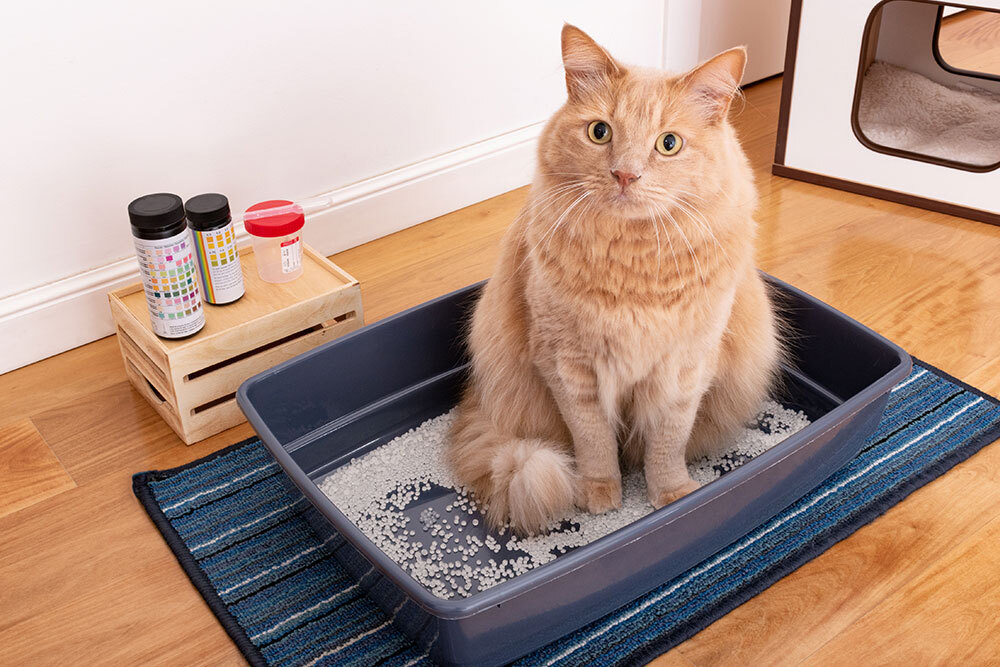
Litter Boxes: Where Most Problems Begin
Most of the everyday issues people bring to us trace back, eventually, to the bathroom situation. Get the bathroom right and a remarkable number of other problems quietly resolve themselves. Litter box issues tend to look complicated and almost always come down to a small set of fixable things.
Box Size, Shape, and Lid Drama
Boxes sold for cats are, on average, about half the size your cat actually wants. The general guideline is that the box should be at least one and a half times the length of your cat from nose to tail base. If your cat regularly does business with their back end on the box and their front end on the floor, this is the gap they’re complaining about. Box choice has several things to consider:
- Open boxes: the simplest, easiest to clean, and what most cats prefer. Visibility is part of why; cats like to see what’s coming.
- Covered boxes: good for odor and litter scatter, but they trap odor in ways some cats hate, and they cut off the cat’s view.
- Top-entry boxes: look tidy, but they ask your cat to jump in and out, which is a problem for senior or arthritic cats, and give no visibility.
- Furniture-style enclosures: hide the box visually, but only work if ventilation is adequate and cleaning access is easy.
The standard for how many is one box per cat plus one extra. The reasoning behind the litter box tips you’ll see repeated everywhere is that cats do not negotiate well over scarce resources. Add boxes, subtract conflict.
Placement, Litter Type, and Hygiene
The right box type in the wrong place, left too long between cleanings, or filled with the wrong litter is just as useless as the wrong box type.
- Location: Quiet corners, away from appliances and entryways. In a multi-floor home, plan for at least one box per level. Keep boxes well separated from food and water.
- Litter selection: What substrate cats prefer is more individual than most people realize. Some cats love clumping clay, others detest it. There’s no universal best. If your cat is making faces at the current setup, trying a different texture can solve the problem.
- Cleanliness: Daily scooping and a full litter change about once a week.
If you’re seeing repeated elimination in one specific spot off the box, the spot is telling you something. Try a different litter, box style, or location, and book a visit if it doesn’t resolve. Sudden litter box changes are also one of the earliest signs of urinary tract disease, kidney disease, and other medical issues that need to be ruled out before assuming the cause is purely behavioral.
Vertical Space: The Square Footage You Already Have
Cats love vertical access. They evolved to use trees, ledges, and rocks to survey their world, and that instinct does not turn off when they move indoors. Options range from minimal to elaborate:
- A few well-anchored wall shelves arranged into a climbing route
- Modular catification furniture systems designed to look like an intentional part of your decor
- Cat home furnishings that combine perches with built-in scratching surfaces
- Simply clearing the top of a tall bookshelf and letting your cat decide it belongs to them now
- A cat tree, window ledges, or hammocks for outdoor observation- bonus points for adding a bird feeder outside
A safety reminder: high-rise syndrome describes the injuries cats sustain from falls, and it happens far more often than people expect, including from second- and third-story windows in regular homes. Any open window or balcony above ground level needs full screening.
Enrichment: Giving Indoor Cats What They Actually Need
Indoor cat enrichment exists because evolution did not get the memo that your cat now lives in a climate-controlled house with reliable food. The instincts to hunt, climb, scratch, and explore are running constantly. When those instincts have nowhere to land, they tend to surface as the 5 a.m. zoomies, the ankle ambush, or the inexplicable shredding of the bath mat.
Hunting, Play, and Finishing the Sequence
Hunting in cats is a full sequence: search, stalk, chase, pounce, catch, kill, eat. Each step builds on the one before, and the whole thing only works if it resolves with a catch and a meal.
Structuring play around the actual hunting behavior of cats fixes this:
- Start with prey-like movement: small, low to the ground, erratic, sometimes hidden behind furniture
- Allow stalking time without rushing the action
- Build to a chase and pounce
- Let your cat actually catch the toy at the end
- Follow with food or a treat to complete the cycle
Skip the resolution and the cat ends up keyed up and unsatisfied even after what looked like a long play session.
DIY Toys and Play Safety
The toys themselves are the easy part. DIY enrichment toys demonstrate that an empty Amazon box, a paper bag, a wad of foil, or a feather tied to a string can compete with anything in the pet store. The variable that actually matters is novelty. Pulling half of your cat’s toys out of circulation for a couple of weeks and bringing them back transforms them into “new” toys without spending a dollar.
A few categories cause more trouble than others:
- String, ribbon, and yarn without supervision can cause linear foreign body obstruction, including string from wand toys. The surgery is unpleasant and expensive.
- Laser pointers can frustrate cats because there is no catchable target. End the session by directing the dot onto a toy or treat your cat can actually grab.
- Small swallowable parts need supervision or removal.
Food as Enrichment
Two meals a day from a bowl is nothing like how a cat is built to eat. In a state of nature, a cat would catch and consume eight to twelve small meals across a day, with every one requiring effort. The bowl arrangement removes effort entirely. This is what food puzzles and slow feeders are for, and there are plenty of homemade puzzle feeders that require nothing more than items you already have at home.
A few formats worth experimenting with:
- Puzzles and kibble-dispensing balls that release food as the cat manipulates them
- Slow-feeding bowls that stretch a meal across more time
- Multiple feeding stations placed around the house so the cat has to move between them
- Hand-feeding small portions to build relationship with a cat who keeps their distance
The wet versus dry food question is real, and many households resolve it by combining the two: wet food at scheduled meals for hydration, dry food in puzzles between meals.
Sensory and Outdoor Enrichment
Cats engage with the world primarily through scent, and most of us underutilize that channel. Catnip is the famous one, with about two-thirds of cats responding genetically. Silver vine and valerian root work for some of the cats who shrug at catnip. Beyond those, scent-based enrichment for cats opens up a category most people never consider: a cinnamon stick rolled into a sock, fresh herbs from the garden, or a pinecone brought in from outside all give your cat something genuinely novel to investigate.
One safety note: many essential oils are toxic to cats, including the oils dispersed by diffusers and warmers. Don’t use essential oils as enrichment, and be cautious about diffusers in any room your cat occupies.
For outdoor stimulation without the dangers of letting cats roam, catios let cats experience sunlight, breezes, and birds without exposure to traffic, predators, or infectious disease. Harness training works for some cats and is a complete non-starter for others; both responses are normal.
Scratching: Redirect, Don’t Eliminate
Trying to make a cat stop scratching is like trying to make a cat stop being a cat. Scratching maintains claw health, deposits territorial scent and visual marks, stretches the long muscles along the back, and works as emotional regulation. The job is to give your cat appropriate options and make the inappropriate ones lose their appeal.
The components of redirecting destructive scratching are mostly about choice and placement:
- Provide multiple scratching posts in different orientations (vertical, horizontal, and angled) and with different materials (sisal rope, sisal fabric, cardboard, carpet) so your cat can show you what they prefer
- Place posts strategically near sleeping areas (cats stretch and scratch when they wake) and near the furniture they’re already using
- Reward your cat when they use the right surfaces and make the wrong surfaces less appealing with double-sided tape, foil, or plastic coverings
- Keep nails trimmed regularly or use nail caps
A note on declawing: it is a painful surgery that removes the last bone of each toe, and it can cause lifelong physical and behavioral consequences including chronic pain, litter box avoidance, and biting. We do not recommend it.
Yes, You Can Train a Cat
Cats are routinely described as untrainable, but they learn quickly when learning produces something they want, which usually means food. They also have a low tolerance for being made to do anything, which means training a cat works in three- to five-minute sessions, not twenty-minute ones. Mental work tires cats out more reliably than physical play; a cat who has done five minutes of focused training often goes straight to a long nap.
Positive reinforcement for cats is the only method that actually works. Punishment doesn’t compute the way humans assume; the cat reads it as a sudden unprovoked attack from the human, which damages the relationship without changing the behavior. Rewarding good cat behavior consistently is also the most efficient way to redirect things you don’t want.
Cooperative Care for Easier Handling
Cooperative care for cats is among the highest-impact applications of training, particularly for cats who become frantic at the carrier or the vet. Teaching a cat to voluntarily enter the carrier, accept paw and ear handling, hold still for nail trims, and tolerate medication transforms what those interactions feel like. The investment is small (food, time, patience) and the payoff is large.
For training rewards, high-value treats like Churu are unbeatable because they’re soft, palatable, and easy to dose in tiny amounts.
Preventing Problems In Multi-Cat Homes
Some cats want a buddy. Others want every other cat to leave. The household with both kinds of cat is where most multi-cat tension comes from, and the first intervention is almost always vertical space. Once cats can pass each other on different planes and claim a perch as their own, a great deal of low-grade friction simply evaporates.
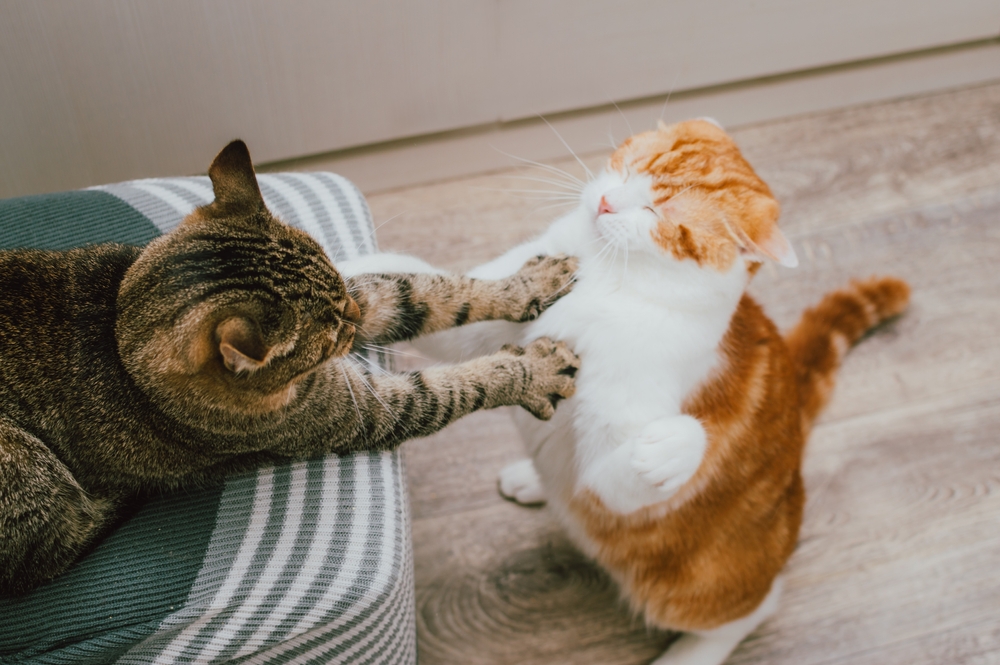
Knowing the difference between playing and fighting is the second skill multi-cat households need.
| Playing | Bullying or Fighting |
| Both cats take turns initiating and receiving | One cat consistently pursues, the other flees |
| Action pauses regularly without either cat fleeing | No pauses; the chase doesn’t reset |
| No hissing or growling | Hissing or growling that escalates rather than settles |
| Both cats stay engaged with each other and the play | The chased cat starts avoiding shared resources like the litter box or food bowl |
| Wrestling and mock-bites with claws sheathed | The pursuing cat begins ambushing rather than wrestling |
When you spot real tension, the practical fixes start with adding resources (more boxes, more food stations, more perches, more hiding spots) and creating multiple escape routes through vertical territory. Products like Feliway release a synthetic pheromone that can help reduce stress and inter-cat aggression.
When Behavior Changes: What’s Going On
The feline life stressors that drive behavior change can be invisible to the humans in the household: a new person living there, a routine that shifted, furniture in a different spot, an unfamiliar cat appearing in the backyard window, more deliveries than usual at the front door. Cats commonly develop a few specific issues when something is off:
- Litter box avoidance with elimination on rugs, beds, or laundry
- Inappropriate scratching on furniture or doorways
- Stress grooming producing bald patches
- Increased vocalization, especially at night
- Aggression between household cats or toward humans
- Withdrawal with hiding more than usual
Cat behavior problems typically have layered causes, and the very first question worth asking is whether something medical is driving the behavior. Urinary tract disease, kidney disease, hyperthyroidism, arthritis, dental pain, and cognitive dysfunction all show up as behavior changes before they show up as anything else. A vet exam should always come before assuming a behavior issue is purely behavioral.
Adjusting the Home for Senior Cats
Cats change as they age, sometimes more than people anticipate. Cognitive dysfunction can produce confusion, disrupted sleep, and middle-of-the-night yowling. Arthritis quietly limits jumping, climbing, and access to high-sided litter boxes. Hearing and vision fade. Behavior changes in older cats are usually some combination of these factors playing out together.
Useful adjustments for senior cats:
- Lower-sided litter boxes that don’t ask an arthritic leg to clear a wall
- Additional boxes placed closer to favorite resting areas to shorten the trip
- Steps or ramps to favorite elevated spots that used to be one easy jump
- Heated bedding for stiff joints
- More frequent vet check-ins to catch emerging conditions early
These aren’t dramatic interventions. They’re small adjustments that recognize the cat in front of you now is not the same cat they were five years ago.
Frequently Asked Questions About Cat Home Setup and Enrichment
My cat seems bored. What’s the easiest thing to change?
Two things, usually. Add a food puzzle to at least one meal a day, and add some vertical territory near a window. Both produce noticeable changes in most cats within a couple of weeks.
My cat is suddenly using the bathroom outside the box. What do I do?
A vet visit first. Sudden changes in litter box use are one of the most reliable early signs of urinary tract disease, kidney disease, and other medical problems. Once medical causes are ruled out, look at what changed environmentally: a new pet, a moved box, a different litter, a stressor in the household.
Are scented litters and air fresheners safe?
Heavily scented litters can deter cats, since cats have a much more sensitive sense of smell than people do. Plug-in air fresheners and essential oil diffusers can be actively dangerous depending on the product. Unscented litter and good ventilation are the safer defaults.
A Home That Works for Both of You
A cat-friendly home is rarely a renovated home. It’s the same home with a few choices made with the cat in mind: enough boxes in the right places, vertical space to climb, daily play that ends with a catch, food that takes a little effort to get to, scratching options where you’d rather they scratch, and some quiet places to disappear when the household gets busy.
If you’re working through a specific issue, just brought a new cat home, or want a tune-up on what you already have set up, we’d love to help. Our team is always glad to talk through specific behavior questions, whether at a wellness visit or as a dedicated consultation. Reach out and we’ll figure out the next right step together.




Leave A Comment